A key supplier misses a shipment in China. Procurement isn’t alerted until it’s too late. Production lines in the U.S. are hours from shutting down.
Inventory teams scramble to secure alternatives, but outdated spreadsheets and siloed systems slow everything down. By the time a workaround is in place, the cost is clear: millions in lost revenue, expedited shipping fees, and reputational damage.
Scenarios like this play out every day when supply chains aren’t integrated:
- Warehouse teams track inventory in one system.
- Procurement uses another system, completely disconnected from what’s actually happening with customer demand.
- Logistics teams rely on manual coordination via messy emails and spreadsheets.
Today’s supply chains must operate with speed, agility, and resilience. Yet many organizations remain constrained by fragmented systems that cost them time, visibility, and trust.
- Operational Inefficiency: Manual coordination and disconnected tools slow responses and inflate costs.
- Increased Exposure to Risk: Inadequate visibility hampers forecasting, decision-making, and crisis response.
- Erosion of Customer Confidence: Delays and fulfillment errors directly impact satisfaction and long-term loyalty.
This guide outlines E7’s unified approach to modernizing supply chain operations that enables faster decisions, lowers costs, and delivers stronger service across the board.
Why Fragmentation No Longer Works
Supply chains today are no longer linear. They’re dynamic, distributed, and exposed to continuous disruption. As complexity grows, fragmented operations become increasingly unsustainable. Learn more about the 5 hidden costs of supply chain fragmentation and how they quietly erode your bottom line.
Here is what’s changed and why a unified approach is now essential:
- Rising Customer Expectations
Speed, reliability, and transparency are the new table stakes. Delays, stockouts, or unclear fulfillment timelines quickly erode loyalty. According to McKinsey, 70% of consumers are willing to switch retailers or brands just to avoid stockouts. - Constant Global Disruption
Whether it’s a pandemic, tariffs that get declared and revoked on a seemingly weekly basis, or wild weather, supply chains face near-constant turbulence. Businesses without real-time insight or the ability to adapt quickly are left reacting instead of leading. - Accelerating Technology Shifts
IoT, AI, and automation have transformed what’s possible. Competitors leveraging real-time data are optimizing faster, reducing costs, and outperforming those that aren’t. Deloitte reports that 79% of companies with high-performing supply chains are achieving greater than average industry growth.
The Hidden Costs of Fragmentation
When your supply chain is fragmented, your bottom line suffers. Here’s how:
Time lost to manual coordination
Delayed, unclear, or inconsistent decision-making
Inventory discrepancies and fulfillment errors
Increased compliance and risk exposure
Revenue loss from missed demand and poor service
5 Hidden Costs of Supply Chain Fragmentation — And How They’re Undermining Your Profitability
Read more
Introducing Supply Chain Unification (SCU): A Service Management Approach
Technology alone isn’t the answer. The real differentiator is how teams operate.
Supply Chain Unification (SCU) is E7’s approach towards the transformation of existing supply chains from reactive systems into resilient, responsive networks.
With SCU, E7 helps organizations:
- Break down silos by standardizing workflows across procurement, production, logistics, IT, and fulfillment
- Replace manual firefighting with automated, trackable processes
- Act faster and smarter, with real-time data powering every escalation and decision
- Align teams and systems around shared outcomes — not disconnected tools
For modern supply chains, unification isn’t optional. The question isn’t if, but how fast you can transform.
Defining SCU
Leveraging powerful Atlassian tools like Jira Service Management and Confluence, E7’s SCU approach introduces a service management layer that connects existing platforms and teams through standardized, trackable workflows.
This operational layer touches on every aspect of the SCOR (Supply Chain Operations Reference) model, enabling unified execution across:
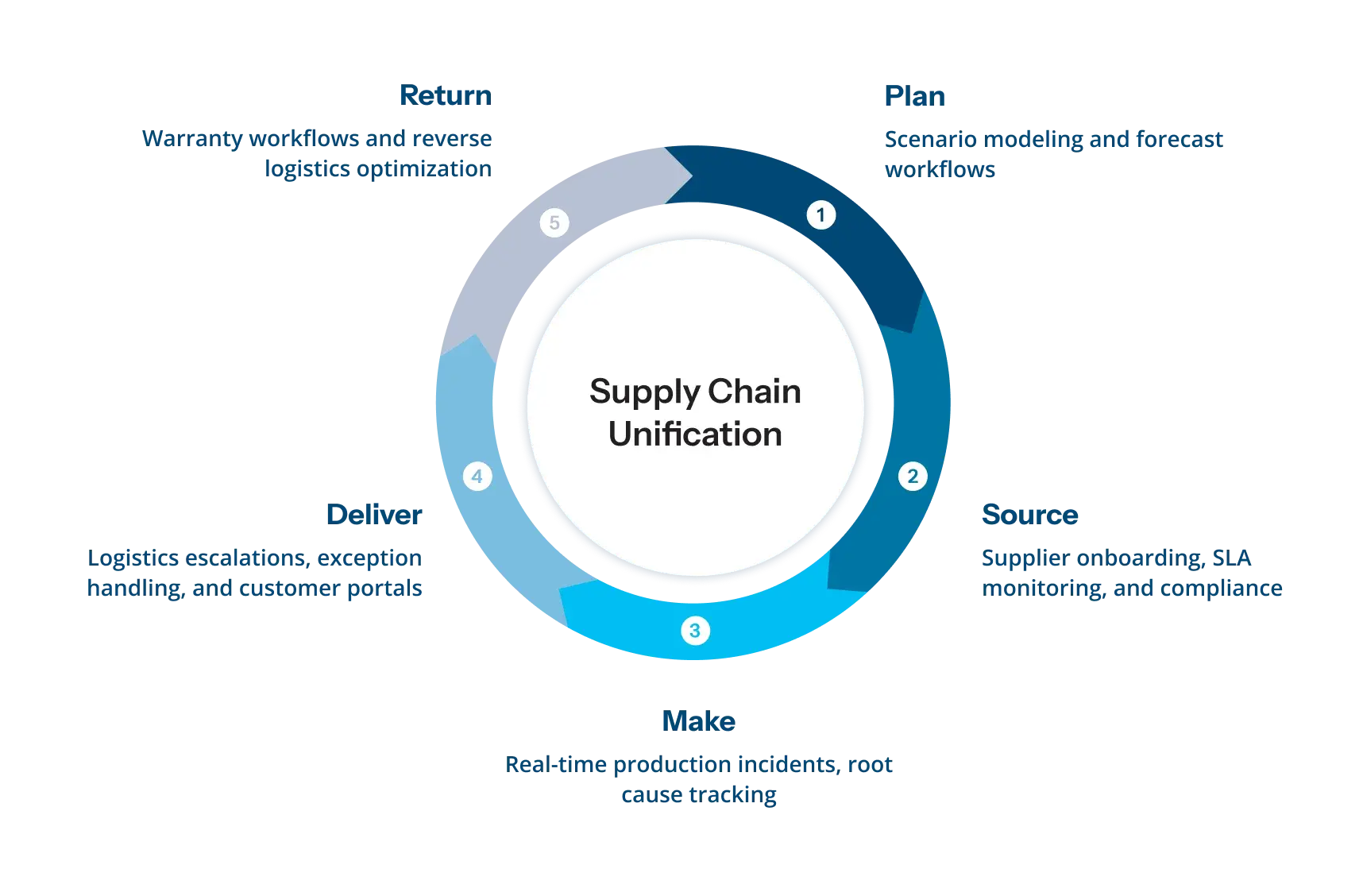
When implemented successfully, SCU eliminates the delays, guesswork, and misalignment that often plague distributed supply chain operations and replaces them with a service-oriented model that scales.
How SCU Differs from Platform Consolidation
Many companies confuse platform consolidation with supply chain unification, but they are not the same.
| Aspect | Platform Consolidation | Supply Chain Unification |
| Scope | Merging IT systems to reduce complexity. | Creating a service management layer that connects processes, teams, and technology across the entire supply chain. |
| Objective | Reducing IT costs and system redundancies. | Enabling real-time visibility, standardized workflows, and faster decision-making across functions. |
| Integration Depth | Limited to specific functions (e.g., ERP, CRM). | Comprehensive, cross-functional unification with service management workflows overlaid across all systems. |
| Impact | Improves IT efficiency. | Transforms operational agility, resilience, and collaboration at the enterprise level. |
Technology alone isn’t the answer. The real differentiator is how teams operate.
Supply Chain Unification (SCU) is E7’s approach towards the transformation of existing supply chains from reactive systems into resilient, responsive networks.
With SCU, E7 helps organizations:
Break down silos by standardizing workflows across procurement, production, logistics, IT, and fulfillment
Replace manual firefighting with automated, trackable processes
Act faster and smarter, with real-time data powering every escalation and decision
Align teams and systems around shared outcomes — not disconnected tools
For modern supply chains, unification isn’t optional. The question isn’t if, but how fast you can transform.
How SCU Powers the SCOR Model
With Supply Chain Unification (SCU), E7 brings five essential capabilities to life across your operations:
Visibility. Alignment. Agility. Stability. Performance Management.
These aren’t abstract qualities. They manifest in the way work flows across your supply chain.
Here’s how each SCOR domain is elevated by these capabilities in action:
Plan
Visibility & Agility
Objectives: Improve forecast precision and planning responsiveness
Impact: SCU unifies planning workflows, bringing together demand signals, scenario models, and operational inputs in one place.
- Centralizes planning data and documentation across teams using Confluence
- Standardizes review and approval cycles with embedded SLAs
- Enables escalations when assumptions break or plans fall out of sync
Result: Shorter planning cycles, improved alignment with sourcing and production, better preparedness for volatility.
Source
Alignment & Performance Management
Objectives: Strengthen supplier reliability and governance
Impact: SCU standardizes how supplier issues are tracked, escalated, and resolved — no more disconnected email threads or informal approvals.
- Automates onboarding, risk assessments, and compliance tracking
- Monitors SLA performance with real-time alerts and dashboards using Atlassian Analytics
- Routes exceptions (like delivery delays or quality issues) through consistent workflows
Result: Faster time to engagement, lower compliance risk, and clearer supplier accountability.
Make
Stability & Agility
Objectives: Minimize downtime and accelerate production response
Impact: By embedding incident workflows into production systems, SCU helps teams resolve issues quickly — and learn from them.
- Triggers real-time escalation when anomalies are detected
- Enables root cause analysis and cross-team documentation (e.g. OT + IT + QA)
- Connects production events directly to upstream Plan and Source inputs
Result: Improved throughput, faster issue containment, and better-informed adjustments.
Deliver
Visibility & Stability
Objectives: Improve fulfillment accuracy and customer experience
Impact: SCU brings structure to last-mile logistics by integrating issue tracking, escalation, and partner communication.
- Provides real-time delivery status and exception alerts
- Enables self-service portals for distributors and internal teams using Jira Service Management
- Automates resolution paths for shipping delays, damage claims, or routing errors
Result: Fewer disruptions, higher service levels, and consistent customer updates.
Return
Performance Management & Alignment
Objectives: Streamline reverse logistics and surface root causes
Impact: Returns, repairs, and warranty claims are captured, routed, and analyzed — not lost in ad hoc workflows.
- Automates intake and categorization of return cases
- Connects returned goods to upstream suppliers or production batches
- Tracks SLA compliance and trends across channels
Result: Reduced return handling time and cost, improved accountability, and insights that prevent recurrence.
Why Service Management is Critical to Supply Chain Resilience — and How Unified Platforms Make It Possible
Read more
The Business Case for Supply Chain Unification
Disconnected supply chains do more than delay shipments. They erode margins, increase risk exposure, and obstruct critical decision-making. With SCU, E7 delivers four strategic advantages that directly impact performance and profitability:
1. Improve Efficiency and Reduce Costs
Manual handoffs and redundant processes quietly drain productivity. SCU replaces these inefficiencies with standardized, automated workflows that connect functions end-to-end.
- Automating issue resolution in Source and Make reduces delays and labor overhead
- SLA-backed escalations prevent minor problems from becoming major disruptions
- Integrated workflows cut down rework, rekeying, and duplication across functions.
In fact, companies with unified supply chains see 20–30% productivity improvements due to better collaboration and workflow automation
2. Gain End-to-End Operational Visibility
When operations are fragmented, leaders lack a clear picture of what’s happening and what’s at risk. SCU provides real-time visibility across SCOR domains with dashboards and alerts that surface issues early.
- Monitor supplier performance and inventory risks in a single view
- Track production disruptions, delivery exceptions, and return volumes as they happen
- Connect siloed teams to the same live data — and the same priorities
McKinsey reports a 30–50% improvement in supply chain visibility for companies adopting real-time integrated platforms.
3. Strengthen Resilience and Compliance
Resilience starts with visibility and is sustained through structure. Discover why service management is essential for supply chain resilience and how it powers proactive coordination. SCU embeds service management principles like incident tracking, escalation paths, and change controls etc. into daily operations.
- Proactively detect and respond to disruptions in Make and Deliver
- Maintain audit trails and SLA compliance without manual oversight
- Mitigate supply chain risk through centralized response and resolution protocols
According to Accenture, SCU drives a 25–35% improvement in resilience during disruptions by enabling real-time coordination and risk visibility
4. Accelerate Innovation and Digital Mat
SCU creates a connected foundation for adopting technologies like AI, IoT, and advanced analytics. By unifying processes first, you remove the friction that slows digital transformation.
- Improve forecast accuracy in Plan with structured data inputs
- Enable predictive alerts in Deliver through IoT and workflow integration
- Use real-time incident and performance data to inform continuous improvement
Deloitte found that companies with integrated decision platforms respond to market changes 3x faster than their competitors
Use Cases in Action: How SCU Transforms Supply Chains
Real transformation happens when structure meets execution. These three use cases show how SCU delivered measurable results across different SCOR domains and how E7 does the same for our clients.
Plan + Source
Inventory Management
Challenge: A major retailer constantly faced stockouts and overstock due to poor inventory visibility.
Solution: They deployed RFID tags to track inventory at the item level in real time. RFID scanners in warehouses and stores instantly update a centralized inventory database.
Impact: Immediate visibility means quicker restocking, fewer stockouts, lower inventory costs, and happier customers. Explore how unified platforms deliver visibility and resilience across distributed operations.
Make + Source
Staying Ahead of Disruptions
Challenge: A networking equipment maker faced massive supplier disruptions from a natural disaster, threatening critical components and operations.
Solution: They implemented a unified risk management system, creating a central crisis team that could instantly map supplier statuses and quickly pivot to backup suppliers.
Impact: Despite a major crisis, proactive planning and real-time visibility minimized production downtime and protected revenue.
Make + Deliver + Source
Supplier Escalation
Challenge: A global industrial automation leader struggled with fragmented supplier management systems, manual escalation processes, and limited visibility across thousands of purchase orders—leading to delays, inefficiencies, and increased risk.
Solution: They unified supplier data from SAP, ServiceNow, and SharePoint into Jira Service Management, automating escalation workflows and enabling real-time dashboards to monitor supplier performance and compliance.
Impact: Achieved 140% ROI over 3 years by replacing manual tasks with automation, accelerating supplier issue resolution, and empowering proactive, data-driven decision-making across the supply chain. See how E7 applied SCU in a real-world supply chain transformation case study to drive measurable ROI.
From Pain to Pane: How Unified Supply Chain Platforms Deliver End-to-End Visibility and Resilience
Read more
Is Your Supply Chain Ready for Unification?
Fragmentation rarely feels urgent — until it suddenly is.
At E7, we call this silent buildup of inefficiency and risk fragmentation debt. It’s what happens when siloed systems, manual workarounds, and unaligned workflows accumulate beneath the surface of daily operations. Left unchecked, it undermines agility, obscures visibility, and stalls critical decisions when speed matters most.
The good news? Supply Chain Unification (SCU) was built to resolve exactly this. If any of the signs below sound familiar, it may be time to rethink how your systems, teams, and data come together. Review the 5 signs your tech stack is ready for unification to evaluate your organization’s readiness.
Signs of Fragmentation
- Critical data spread across disconnected systems
- Reliance on manual handoffs and workarounds
- Limited end-to-end visibility across procurement, production, and fulfillment
- Frequent errors in order fulfillment or inventory reconciliation
- Recurring shipment delays and customer complaints
- Persistent misalignment between supply chain, IT, and operations teams
- Inability to respond rapidly to external shocks or internal failure
5 Signs Your Supply Chain Tech Stack is Ready for Unification
Read more
SCU Readiness Framework: Key Areas to Evaluate
At E7, we’ve led dozens of SCU deployments across industries. We’ve found that success hinges greatly on proper alignment across people, processes, and priorities. Based on our experience, the following dimensions consistently determine whether an organization is prepared to unify its supply chain at scale:
Cross-Functional Collaboration
Are supply chain, IT, and operations aligned in process ownership and response coordination?
Workflow Standardization
Do teams manage issues, escalations, and service requests through shared, documented workflows?
Service Management Maturity
Are there existing practices for incident management, change control, and service-level accountability?
Systems Interoperability
Can current platforms integrate into a unified architecture without significant reengineering?
Legacy Modernization Strategy
Is there a roadmap for reducing dependency on outdated, siloed tools?
Executive Sponsorship
Is leadership actively championing both the digital transformation and the operating model change?
Organizational Change Readiness
Are there plans in place for training, adoption support, and cultural alignment?
Feedback and Improvement Mechanisms
Does the organization have systems in place for capturing feedback and driving iterative refinement?
Building Your Unification Roadmap
Unifying your supply chain is a high-impact transformation. Like any other transformation, it requires structure, sponsorship, and staged execution.
At E7, we’ve found that the most successful SCU initiatives follow a phased roadmap that minimizes disruption, builds momentum early, and accelerates measurable outcomes.
Phase 1
Strategic Alignment
- Define business goals tied to SCOR functions (e.g., reduce MTTR in Make, improve supplier compliance in Source)
- Secure executive sponsorship and cross-functional ownership
- Establish a governance model and success metrics (e.g., SLA adherence, cycle time reduction)
Phase 2
Platform and Partner Selection
- Identify platforms that support real-time integration and service management workflows
- Evaluate partners based on supply chain domain knowledge, SCOR fluency, and implementation maturity
- Assess internal capability gaps in areas like change management or system integration
Phase 3
Targeted Implementation
- Start with high-impact domains (e.g., supplier escalation in Source, production incidents in Make)
- Deploy unified workflows, dashboards, and alerts using tools like Jira Service Management and Confluence
- Deliver enablement and hands-on training to all impacted teams
Phase 4
Optimization and Scale
- Monitor real-time performance via dashboards and feedback loops
- Refine workflows based on user behavior and issue patterns
- Expand SCU practices to additional domains and regions as maturity grows
Selecting the Right Partner for SCU
In our work with enterprise supply chains, we’ve seen that SCU success depends as much on strategic alignment and operational fluency as it does on tooling. Choosing the right implementation partner means looking beyond features to assess domain expertise, delivery maturity, and long-term fit.
What to Look For
SCOR Expertise
Can they tie platform features to real-world supply chain challenges?
Service Management Fluency
Do they specialize in ITSM/ESM principles like incident handling, escalation workflows, and SLA compliance?
Platform Experience
Are they recognized experts in platforms like Jira Service Management, Confluence, and Atlassian Analytics?
Change Management Depth
Can they drive user adoption, role-based training, and post-go-live optimization?
Key Questions to Ask
- What experience do you have with SCU deployments in our industry?
- Can you provide proven case studies with quantifiable outcomes?
- How does your platform enable real-time synchronization and workflow unification?
- What service management capabilities are built into the solution?
- What does your support model look like post-deployment?
Warning Signs
- Limited integration or data interoperability
- Generic solutions with minimal supply chain context
- Weak implementation support and training resources
- Lack of transparent customer success metrics
Why E7
As an Atlassian Platinum Solution Partner and SCOR-aligned supply chain integrator, E7 combines the tools and transformation strategy to make unification work.
140% ROI delivered through real-world SCU deployments
Custom workflow design mapped to your supply chain’s structure
Proven success across manufacturing, tech, retail, and more
Strategic advisory, implementation, and continuous optimization — all in one team
Your systems don’t need to be replaced. Your processes do. We help you rebuild them with service management at the center.
Choosing the Right Supply Chain Unification Partner: 5 Criteria to Evaluate
Read more
Let E7 Prep Your Supply Chain for the Future with SCU
In conclusion, Supply Chain Unification (SCU) is a strategic approach that builds resilience, responsiveness, and cross-functional efficiency into the fabric of your supply chain.
Here’s what SCU delivers:
Operational Efficiency
Eliminate redundant tasks and streamline workflows across functions
Real-Time Visibility
Gain continuous insight into procurement, inventory, logistics, and fulfillment
Adaptive Resilience
Respond quickly to disruptions and regulatory shifts with coordinated agility
Digital Readiness
Establish the foundation for AI, automation, and analytics at scale
If your current operations feel fragmented, reactive, or overly dependent on manual coordination, the case for unification is clear.
The next step? Contact us to learn more about our Supply Chain Unification assessment OROR grab the ebook below for a clear, step-by-step plan to get started.
Strategies for Resilience and Agility
Aligned with the SCOR model, Supply Chain Unification connects people, data, and processes, enabling cross-functional collaboration and process automation through a unified platform.
Download now